Thursday, December 13, 2007
The Network Layer
The network layer (sometimes called the internet layer) handels the movement of packets around the network. Routing of packets, for example, takes place here. IP (Internet Protocol), ICMP (Internet Control Message Protocol), and IGMP (Internet Group Management Protocol) provide the network layer in the TCP/IP protocol suite.

The link layer
Sometimes called the data-link layer or network interface layer, normally includes the device driver in the operating system and corresponding network interface card in the computer. Together they handle all the hardware details of physically interfacing with the cable (of whatever type of media is being used).
Thursday, December 6, 2007
Layering
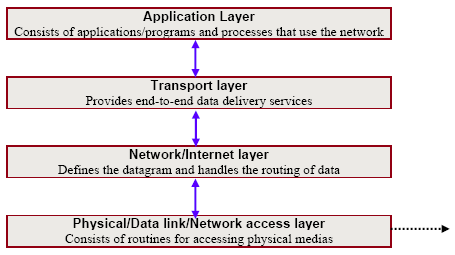
Networking protocol are normally developed in layer, with each layer responsible for a different faced of the communications. A protocol suite , such as TCP/IP, is the combination of different protocol at various layer. TCP/IP is normally considered to be a 4-layer system, as shown in Figure.
Wednesday, December 5, 2007
Introduction
The TCP/IP protocol suite allow computers of all sizes, from many different computer vendors, running totally different operating systems, to communicated with each other. It is quite amazing because its use has far exceeded its original estimates. What started in the late 1960s as a government financed research project into packet switching network has, in the 1990s, turned into the most widely used form of networking between computers. It is truly an open system in that the definition of the protocol suite and many of its implementations are publicly available at litte or no charge. It forms the basis for what is called the worldwide Internet, or the Internet, a wide area network (WAN) of more than one million computer that literelly spans the globe.
Subscribe to:
Posts (Atom)